
25-03-2026 10:35
Hulda Caroline HolteHello,I collected this species growing on a dead b
30-03-2026 12:03
 William Slosse
Hello all,On 27/03/26, in Kraaiveld in Wingene (Be
30-03-2026 09:53
Yanick BOULANGERBonjourVoici des petites fructifications poilues s
27-03-2026 10:47
Åge OterhalsI have tentatively identified this Stictis to S. f
28-03-2026 07:55
 Marc Detollenaere
Hello everybody,Yesterday I found a number of whit
26-03-2026 15:31
 Åke Widgren
Hello,I found this one in October last year, on r
27-03-2026 15:23
Gernot FriebesHi,this Trichopezizella deviates from typical T. b
27-03-2026 15:08
Gernot FriebesHi,I'm looking for help with this coelomycete on C
Phaeosphaeria epicalamia??
Mlcoch Patrik,
11-03-2017 18:30
 Hello to everyone,
Can be this Phaeosphaeria epicalamia? Pseudothecium subglobose, subepidermide, 500 um wide, 210 um high, ostiole conic, 112 um wide. Ascus cylindrical, 70 - 100 x 7,5 - 12,2 um. Ascospore biseriate, 5 - 6 (rare 7) septate, brown, fusoid, third cell largest, (23,5)24 - 27 x 5 - 6,5 um, Q=4,6.
On dead steams of the Calamagrostis sp.
Please about determinate, Thank you.
Patrik Ml?och
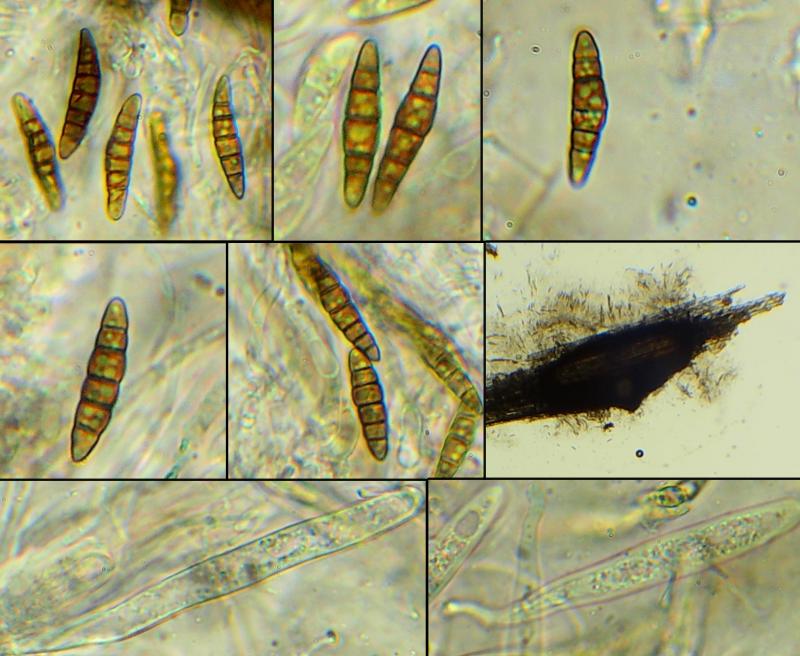
Peter Thompson,
12-03-2017 00:11
Re : Phaeosphaeria epicalamia??
Hello Patrik,
It seems that the entry in the Ascofrance database shows Phaeosphaeria epicalamia as having 5-septate spores with the second cell swollen, so this is different from yours.
I think that the spores which you illustrate with more than 5 septa are in poor condition and may have developed one or two more septa because of becoming over mature.
If the spores of your sample are mostly 5-septate, the Ellis & Ellis book Microfungi on Land Plants suggests Phaeosphaeria luctosa as having been recorded on Calamagrostis. The spores of this species closely resemble the spores of your collection, which are in good condition.
I suggest that this would be most likely to be your fungus.
With Best Wishes,
Peter Thompson.
It seems that the entry in the Ascofrance database shows Phaeosphaeria epicalamia as having 5-septate spores with the second cell swollen, so this is different from yours.
I think that the spores which you illustrate with more than 5 septa are in poor condition and may have developed one or two more septa because of becoming over mature.
If the spores of your sample are mostly 5-septate, the Ellis & Ellis book Microfungi on Land Plants suggests Phaeosphaeria luctosa as having been recorded on Calamagrostis. The spores of this species closely resemble the spores of your collection, which are in good condition.
I suggest that this would be most likely to be your fungus.
With Best Wishes,
Peter Thompson.
Chris Yeates,
12-03-2017 13:32

Re : Phaeosphaeria epicalamia??
Hello Patrik
As pointed out by Peter Thompson Phaeosphaeria epicalamia has the second cell from the apex broadest - see Enrique Rubio's recent addition to the Database; in that it somewhat resembles P. nigrans.
I have run your fungus through the keys in Shoemaker & Babcock's Monograph in Canadian Journal of Botany 67: pp.1500-99, (1989) and it comes out in their subgenus Vagispora. Although your spore measurements are rather on the short side I agree with Peter, I think this is P. luctuosa, which has a wide host range within the Poaceae. Compare with http://www.ascofrance.com/search_recolte/2765 and http://www.ascofrance.com/search_recolte/4327 (zoomable PDF also available with the latter).
Cordialement
Chris
As pointed out by Peter Thompson Phaeosphaeria epicalamia has the second cell from the apex broadest - see Enrique Rubio's recent addition to the Database; in that it somewhat resembles P. nigrans.
I have run your fungus through the keys in Shoemaker & Babcock's Monograph in Canadian Journal of Botany 67: pp.1500-99, (1989) and it comes out in their subgenus Vagispora. Although your spore measurements are rather on the short side I agree with Peter, I think this is P. luctuosa, which has a wide host range within the Poaceae. Compare with http://www.ascofrance.com/search_recolte/2765 and http://www.ascofrance.com/search_recolte/4327 (zoomable PDF also available with the latter).
Cordialement
Chris
Mlcoch Patrik,
12-03-2017 14:07
Re : Phaeosphaeria epicalamia??
Thank you,
I determinated by Phaeosphaeria (Shoemaker and Babcock) and I more likely looking for between subgenus Sicispora.
I determinated by Phaeosphaeria (Shoemaker and Babcock) and I more likely looking for between subgenus Sicispora.
Chris Yeates,
12-03-2017 14:29
Re : Phaeosphaeria epicalamia??
Yes, that can be a difficult separation. The confusion can arise by what they mean by the "first septum". I have always taken it to mean the first septum to develop as the spores mature. A useful guide is that this is usually the most constricted one.
Mlcoch Patrik,
12-03-2017 17:08
Re : Phaeosphaeria epicalamia??
O.K. Thank you for clarification Chris.