
31-03-2026 08:19
 Bernard CLESSE
Bonjour à toutes et tous,Pourriez-vous m'aider à
30-03-2026 12:03
 William Slosse
Hello all,On 27/03/26, in Kraaiveld in Wingene (Be
25-03-2026 10:35
Hulda Caroline HolteHello,I collected this species growing on a dead b
30-03-2026 09:53
Yanick BOULANGERBonjourVoici des petites fructifications poilues s
27-03-2026 10:47
Åge OterhalsI have tentatively identified this Stictis to S. f
28-03-2026 07:55
 Marc Detollenaere
Hello everybody,Yesterday I found a number of whit
26-03-2026 15:31
 Åke Widgren
Hello,I found this one in October last year, on r
27-03-2026 15:23
Gernot FriebesHi,this Trichopezizella deviates from typical T. b
Psilachnum possible # 50678
Roland Labbé,
06-05-2017 01:32
Voici possiblement un Psilachnum.
Nous vous remercieons de nous aider à l'identification de ce disco.
Amitiés !
Roland
Données :
Date de récolte : 23 / 10 / 2015
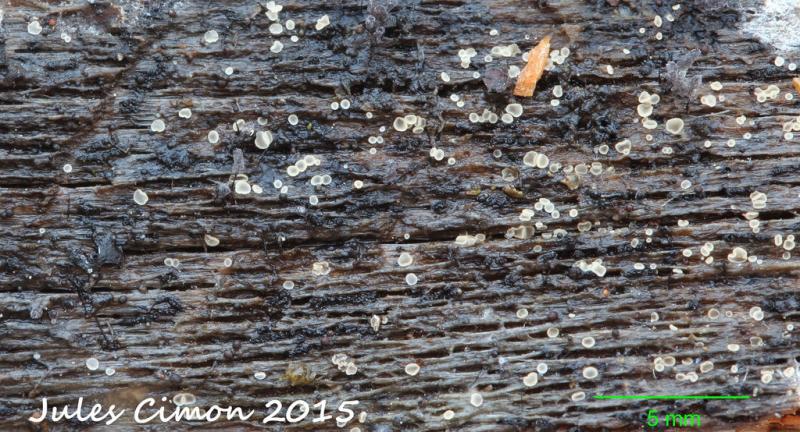
Substrat : bille de feuillu en décomposition au sol d'une forêt de feuillus
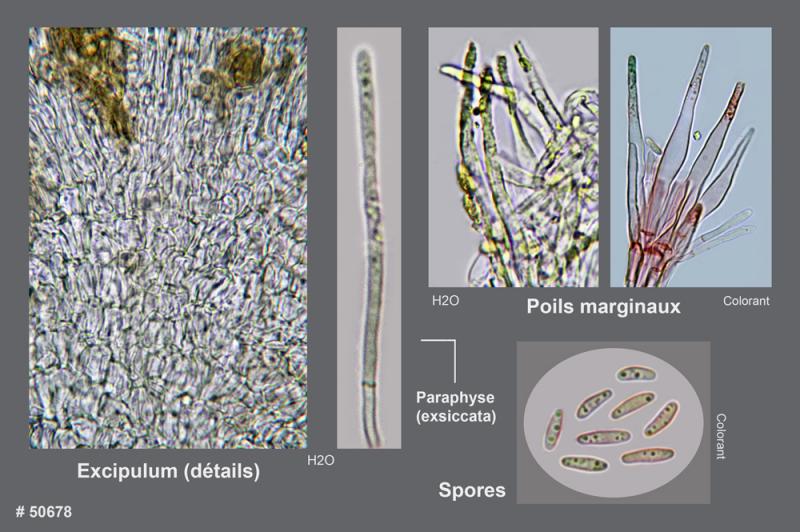
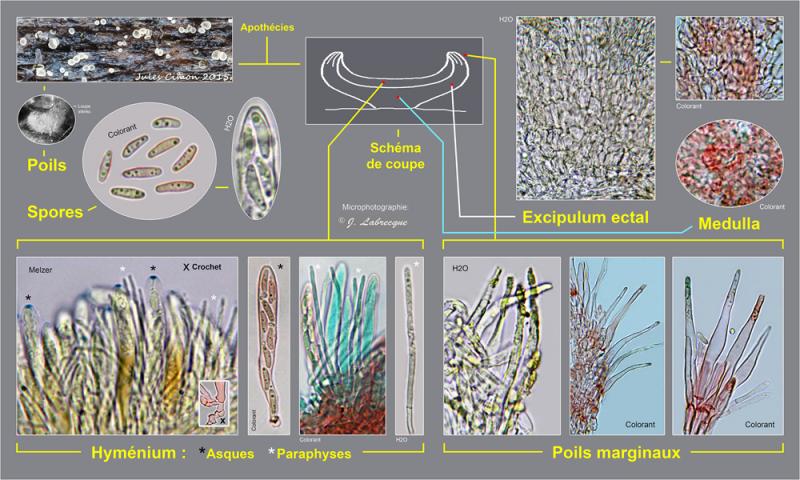
Apothécie jusqu'à 0,8 mm de diam., cupuliforme, étroitement sessile, hyaline à blanchâtre, à marge finement ornée de poils hyalins couverts d'incrustations réfringentes dorées
Spores étroitement ellipsoïdes à cylindriques, parfois légèrement arquées, lisses, non septées, avec 2 ou 3 petites guttules, hyalines réfringentes, 5,9-7,1 x 1,6-1,9 µm, Q = 3,8
Asques cylindriques, à 8 spores bisériées, avec crochet basal et pore apical amyloïde, à contenu dextrinoïde, 31,8-38,4 x 4-5 µm
Paraphyses cylindriques, non ramifiées, parfois légèrement renflées vers l'apex, avec un septum au tiers inférieur, à contenu difficile à préciser (exsiccatum), hyalines, 37,2-45,2 x 1,2-2,4 µm
Medulla en textura epidermoidea/angularis, formée de cellules gélatinisées, hyalines
Excipulum ectal en textura angularis, formé de cellules à paroi légèrement épaissie, hyalines, 6-9 x 3,2-7 µm
Poils marginaux dispersés, lancéolés, non septés, hyalins, couverts d'une substance incrustante réfringente d'aspect doré, à contenu apical granuleux réfringent, 29-50 x 3,4-5,4 µm
Hans-Otto Baral,
06-05-2017 09:55

Re : Psilachnum possible # 50678
Hi Roland
as always, in the living state it would be much easier.
I consider this to be a Hyaloscypha, based on the hairs and lignicolous habitat.
Psilachnum would be recognizable, e.g., by its VBs in the living paraphyses and hairs.
Zotto
as always, in the living state it would be much easier.
I consider this to be a Hyaloscypha, based on the hairs and lignicolous habitat.
Psilachnum would be recognizable, e.g., by its VBs in the living paraphyses and hairs.
Zotto