
05-04-2026 22:46
 Lothar Krieglsteiner
on wood of Ceratonia, Algarve, 3.4.2026.The color
05-04-2026 20:40
 Robin Isaksson
Hi!Found i Japan on bark of Abies sp. Spores 35-4
31-03-2026 21:18
 Miguel Ángel Ribes
Good evening. oes anyone have the original descrip
31-03-2026 20:57
Stefan BlaserHello everybody, I hope somebody can help me with
26-03-2026 15:31
 Åke Widgren
Hello,I found this one in October last year, on r
31-03-2026 16:20
 Mlcoch Patrik
Hello, Please about help with determination. On
31-03-2026 08:19
 Bernard CLESSE
Bonjour à toutes et tous,Pourriez-vous m'aider à

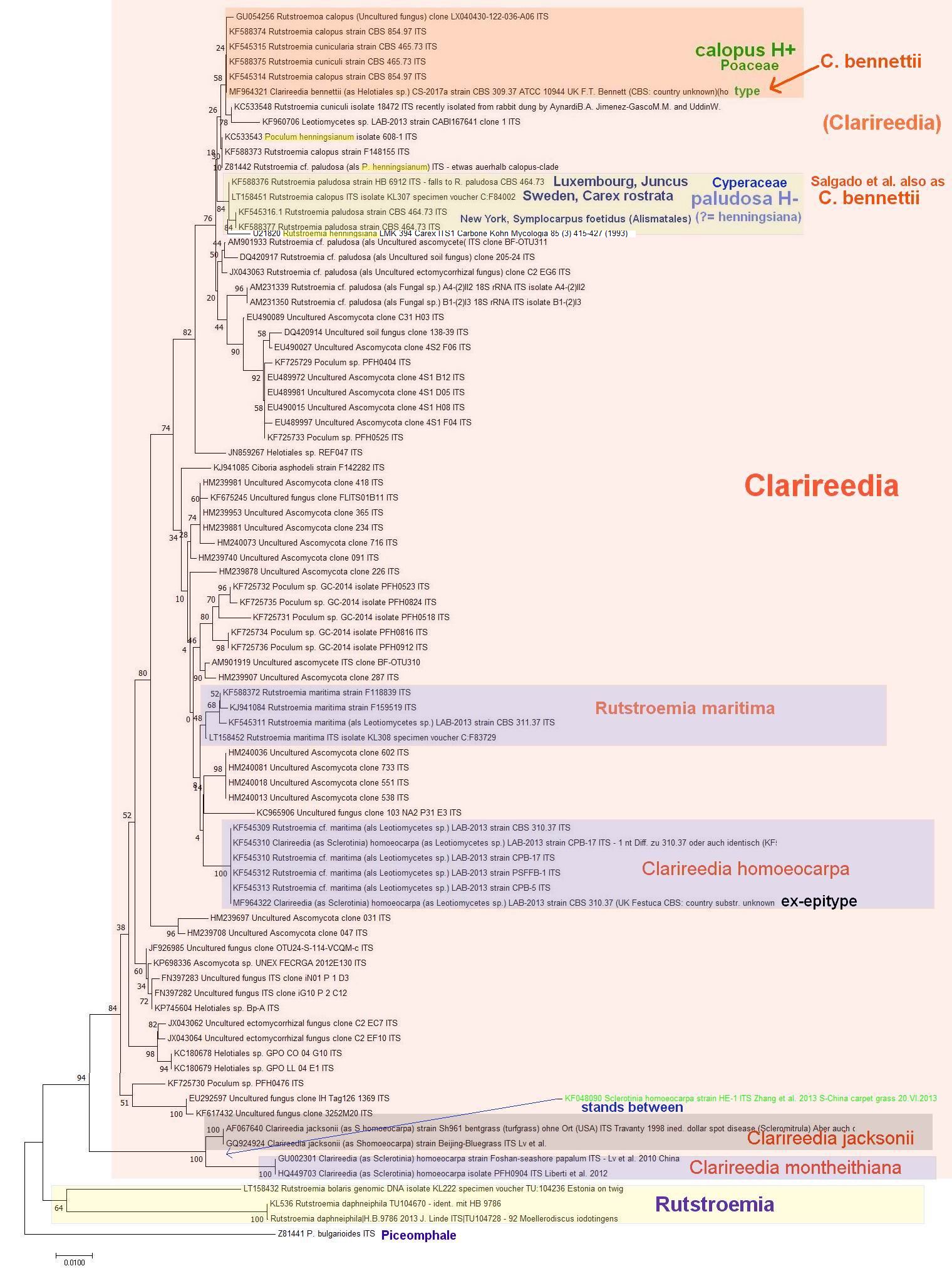
I have long been interested about fungi of peat bogs and wetlands in the central part of the Czech Republic. I often find the taxon Rutstremia henningsiana / paludosa in the tall-sedge beds. In the Mycobank and IndexFungorum databases are still distinguished as two species. I have read carefully the debates on the web sites Ascofrance about the taxonomy of this complex in the past. They showed that it is only one species and Rutstremia henningsiana is an older and invalid name. Has anything changed since then?
Thank you for answer

you are right, and it was me to suggest that henningsiana is an older name for paludosa. But this is mainly based on the substrate Cyperaceae, while the crucial character, the absence of croziers, was probably never tested in the type materials. With a narrow generic concept one may use Clarireedia for this species, with C. bennettii representing a later synonym of R. calopus. The authors who introduced the new genus overlooked this synonymy.
Zotto

In attach you see a comprehensive tree of the group (henningsiana highlighted in yellow).
 Rutstroemiaceae-calopus-group-ITS-31.7.2018-0001.jpg
I can therefore understand that Rutstroemia paludosa / henningsiana and R. calopus are one and the same species which has been combined into one by studying DNA. Authors based on type items? And now a new genus has been established by Saldago et alia where Clarireedia bennetii represents these three species?
Many thanks for the info and explanation of the current situation
Best regards
I remember that several species are parasites of grasses, e.g. on golf places, so of economic importance. But that paper, so helpful it is from a molecular point of view, did not give the final nomenclature, if such will ever be achieved, and no information on croziers.