
26-03-2026 15:31
 Åke Widgren
Hello,I found this one in October last year, on r
27-03-2026 15:23
Gernot FriebesHi,this Trichopezizella deviates from typical T. b
25-03-2026 10:35
Hulda Caroline HolteHello,I collected this species growing on a dead b
27-03-2026 15:08
Gernot FriebesHi,I'm looking for help with this coelomycete on C
27-03-2026 10:47
Åge OterhalsI have tentatively identified this Stictis to S. f
24-03-2026 21:37
Elisabeth StöckliBonsoir,Sur bois (tronc) très pourri de conifère


25-03-2026 22:23
 Marc Detollenaere
Dear Forum,On a debarked stem of Tilia, we found s
24-03-2026 15:44
Åge OterhalsI hope someone can confirm the name of this collec
Lachnellula subtilissima?
Juuso Äikäs,
10-03-2021 10:39
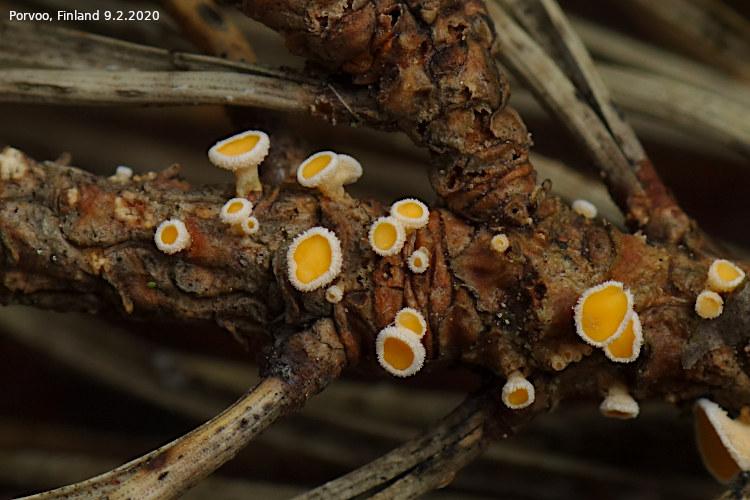
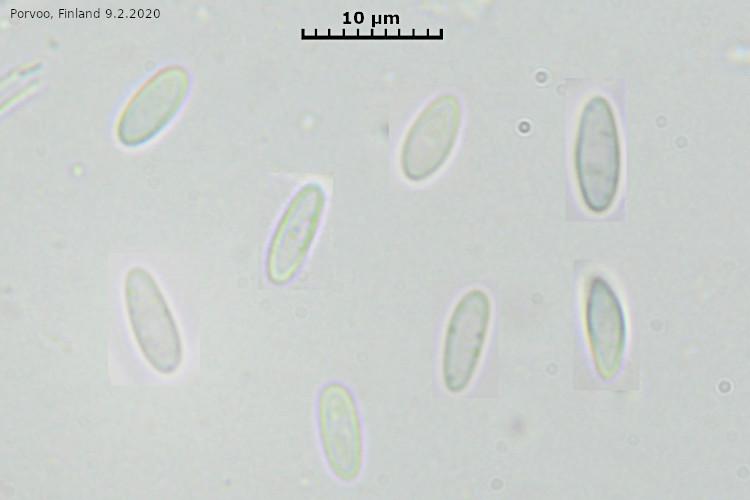
I only have microphotos of spores left and wonder if it can be said only on the basis of spores that this is L. subtilissima or not? The spores measure 6.7 - 8.2 × 2.5 - 3.1 microns.
Hans-Otto Baral,
10-03-2021 10:57

Re : Lachnellula subtilissima?
The spores look too wide for me. Important is the iodine reaction of asci and the ascus base.
Spore size reminds me of L. calyciformis, but shape and lacking drops are contradictory.
Juuso Äikäs,
10-03-2021 11:40
Re : Lachnellula subtilissima?
Ok, thanks. Too bad there isn't other info left. If I correctly remember, both the iodine rection and croziers are variable in L. subtilissima.
Hans-Otto Baral,
10-03-2021 12:25
Re : Lachnellula subtilissima?
Yes, if we really have to do with only one species.
Edward Tuddenham,
10-03-2021 15:15
Re : Lachnellula subtilissima?
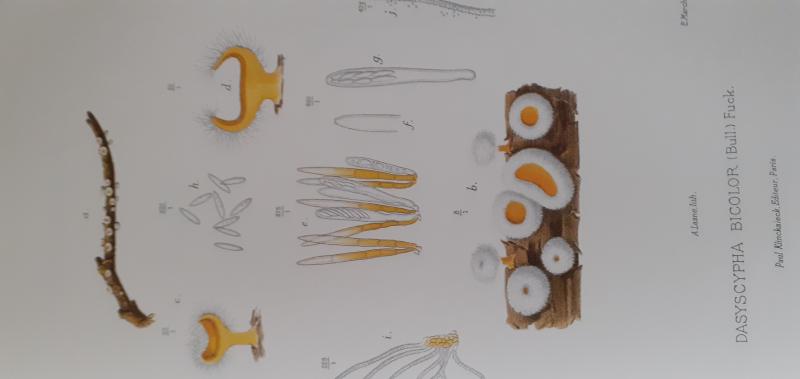
How about Capitotricha bicolour? aka Dasycypha bicolor. It looks exactly like your little discomycetes. As mentioned microscopy is essential to be sure. Your spores would do for this species. I attach the figure from Boudier which does seem remarkably like your nice picture of the cups aligned along a small dead branch.
Juuso Äikäs,
10-03-2021 15:20
Re : Lachnellula subtilissima?
Maybe Pinus sylvestris as a substrate would be a bit strange? If I remember correctly, C. bicolor is restricted to deciduous trees.
Edward Tuddenham,
10-03-2021 15:41
Re : Lachnellula subtilissima?
Good point. It is usually on oak. But substrates can change in the fungal world. With DNA we aught to be able to tell if there is a switch or the species were actually the same all along.
Hans-Otto Baral,
10-03-2021 16:10
Re : Lachnellula subtilissima?
Actually DNA is available for various substrates of C. bicolor, and the result is that there exist a number of species, including my old C. fagiseda (see paper about C. attenuans in Ascomycete.org 2019). ITS is partially very different among these cryptic species. But never I saw a fungus on conifer with such lanceolate protruding paraphyses.