
25-03-2026 10:35
Hulda Caroline HolteHello,I collected this species growing on a dead b
26-03-2026 15:31
 Åke Widgren
Hello,I found this one in October last year, on r


25-03-2026 22:23
 Marc Detollenaere
Dear Forum,On a debarked stem of Tilia, we found s
24-03-2026 15:44
Åge OterhalsI hope someone can confirm the name of this collec
25-03-2026 20:53
François BartholomeeusenDear forum members,On 23 March 2026, I found sever
23-03-2026 20:16
 Miguel Ángel Ribes
Good eveningI'm unable to identify this Coprotus o
25-03-2026 15:06
 Bernard CLESSE
Bonjour à toutes et tous,Pourriez-vous me confirm
25-03-2026 13:54
 Enrique Rubio
Does anyone know where I could download Paoletti's
In the mean time I'd be happy for ideas on what it could be.


However, on the same culm there is now also another species with more yellowish hairs even if not as bright yellow as the one I have interpreted to be T. limonipilosa. The spores are 10.4 - 15.0 × 1.9 - 2.3 µm, with virtually no visible spore content. IKI faintly bluish, no croziers. Would this be T. sulphureopilosa?


These two species are very often found together.
If these are two separate species? As far as I know, work on them has not yet been completed. Zotto knows much more on this subject.
I am wondering, however, a blue reaction to iodine?
Such occurs after pre-treatment of asci in KOH.
Are you sure she was blue?
greetings
Mirek
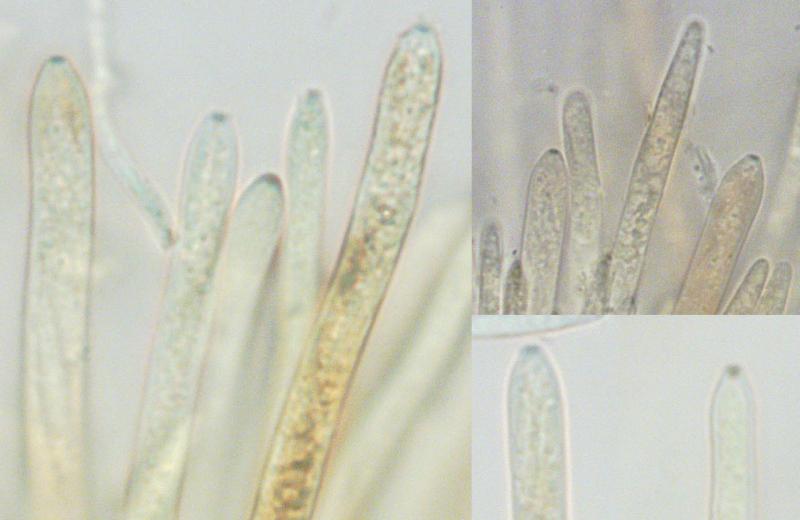
Porus Reaction T. mollissima and T. sulphureopilosa should be red.
Maybe this species is more complex than we think?
Or maybe you have a different genre?
So do you think Stefan used IKI in a low concentration?
Using after Lugol, KOH with low concentration, I also obtained a blue reaction.
How I will find fresh ascomata, I will check more closely.
Thank you Zotto.