
24-03-2026 19:59
 William Slosse
Hello everyone,On 23/03/26, I found the following
21-03-2026 15:13
Lepista ZacariasHello everyone, Does any one know of any literatu
24-03-2026 21:37
Elisabeth StöckliBonsoir,Sur bois (tronc) très pourri de conifère
24-03-2026 21:07
Ethan CrensonHello all, A friend collected this asco in a wood
23-03-2026 20:16
 Miguel Ángel Ribes
Good eveningI'm unable to identify this Coprotus o
24-03-2026 15:44
Åge OterhalsI hope someone can confirm the name of this collec

20-10-2017 09:23
Garcia SusanaEste otro crecía en el mismo trocito de madera qu
Rubus fruticosus disco
Chris Yeates,
14-11-2021 15:47

Bonjour tous
I have been doing some collecting on Rubus fruticosus (agg.) recently, and this is one of several Helotiales I have encountered.
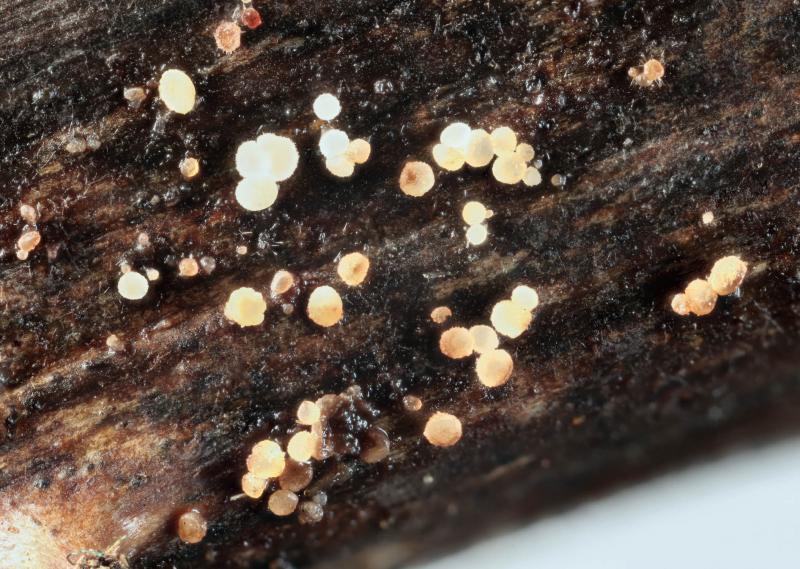
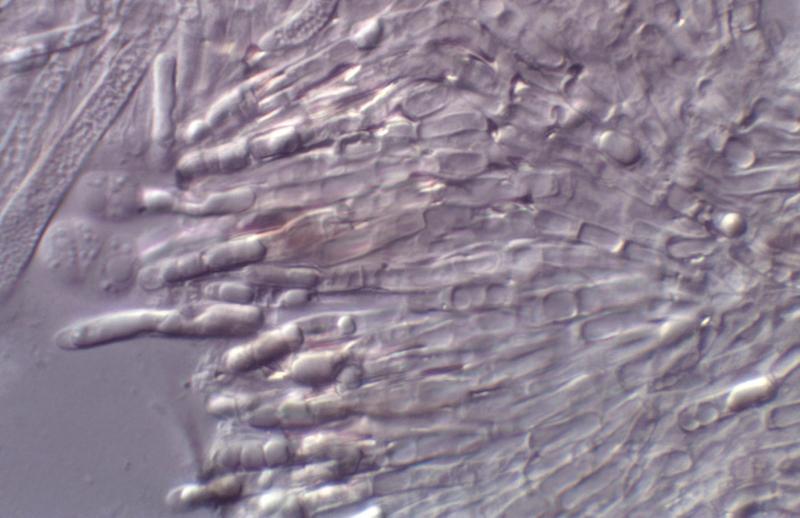
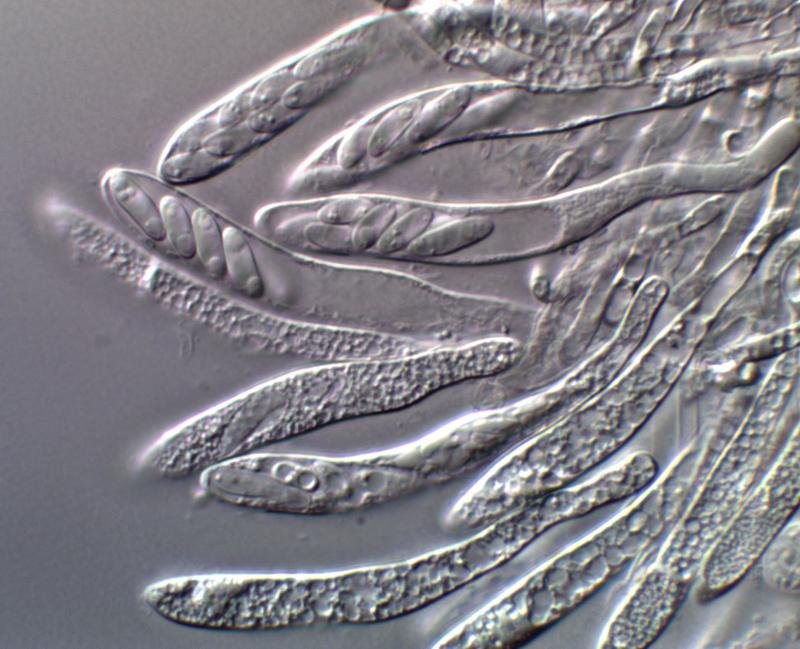
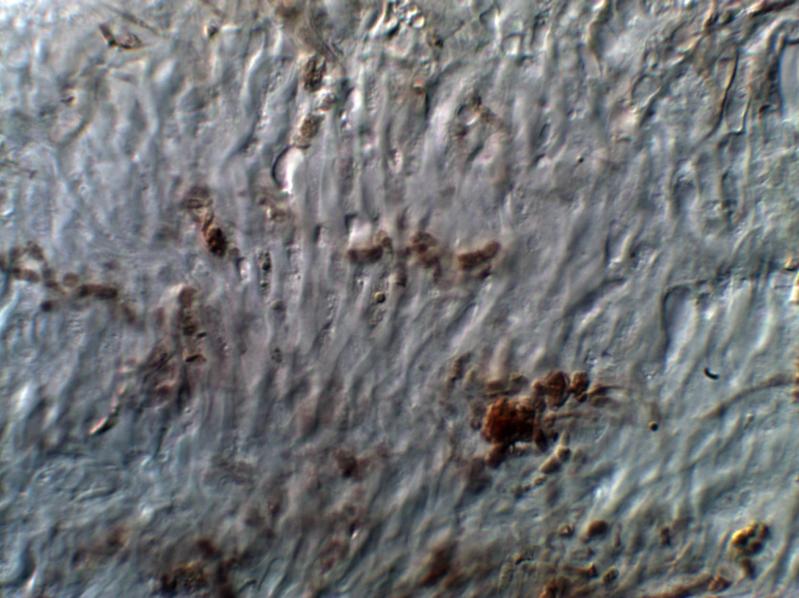
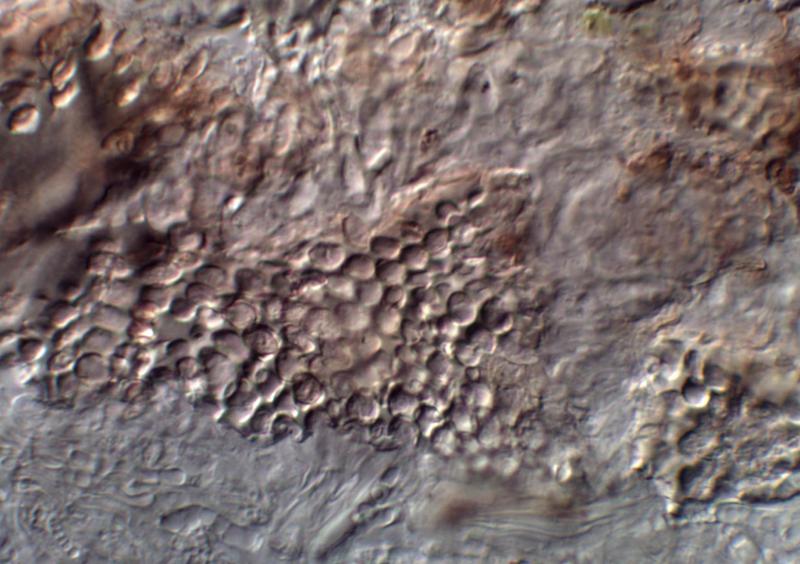
Apothecia subsessile up to 300µm diameter, minutely downy, starting creamy and turning rusty-red, basal cells thick-walled, globose, running into elongated rather glassy hyphae, the terminal excipular cells rather thick-walled and ending in cells with refractive contents as can be seen in the images.
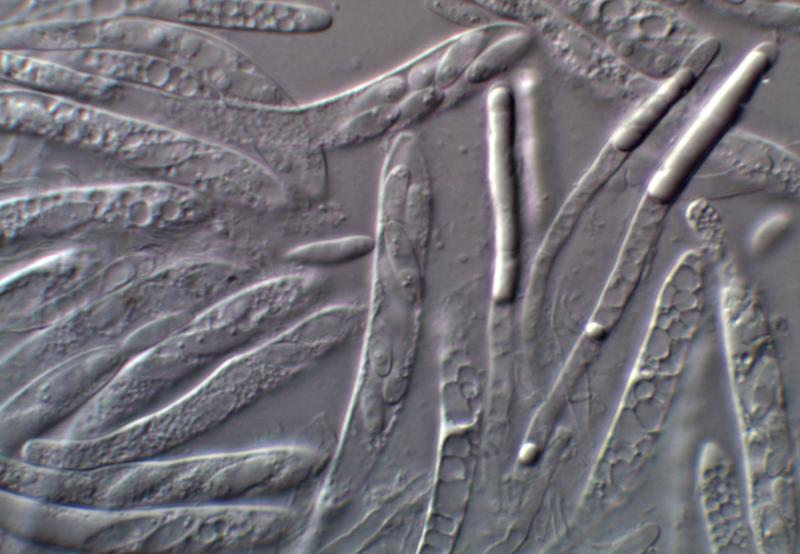
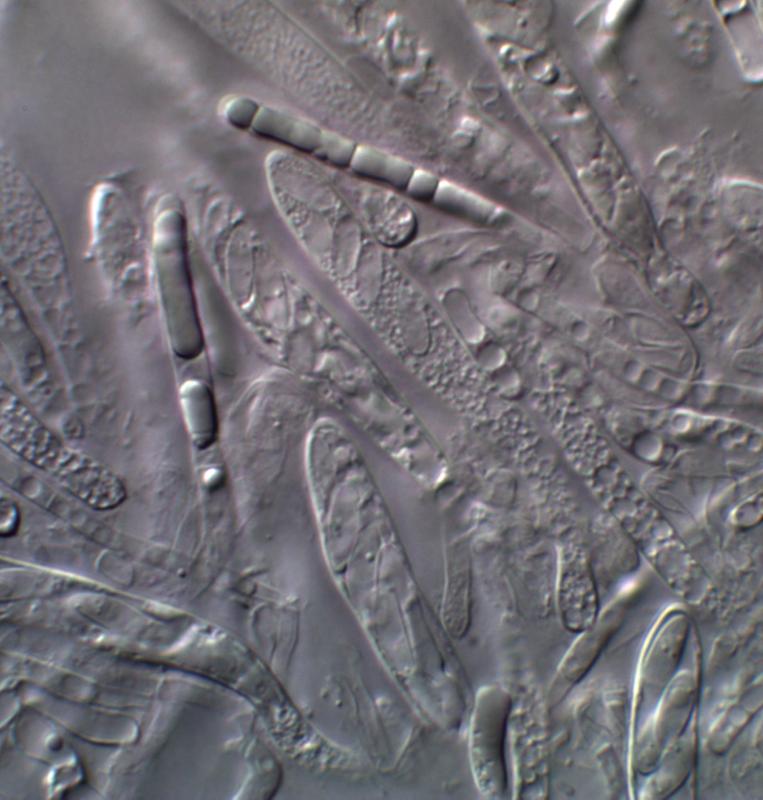
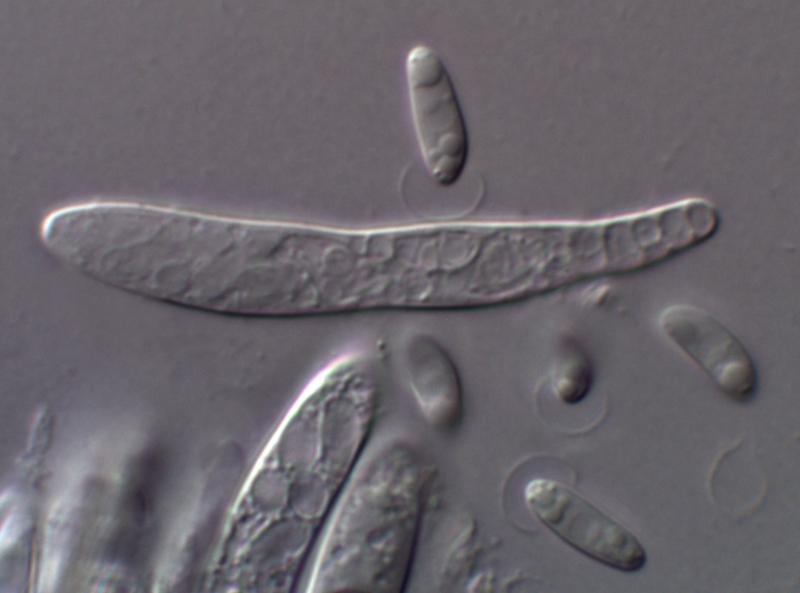
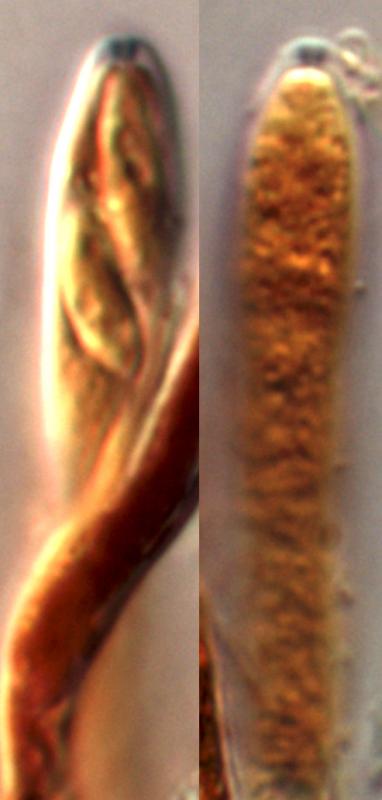
Asci 8-spored, in IKI deep blue, I could not see any croziers. Paraphyses often with extensive continuous to interrupted vacuolar contents. Ascospores (7.2)8.1-8.9 x 2.7-3.2µm, guttules as seen in the images. Enrique Rubio commented recently that many spores of Helotiales, when freshly ejected show a sort of "sheath"; in this instance a number of spores showed a sort of "halo" at one end - see image.
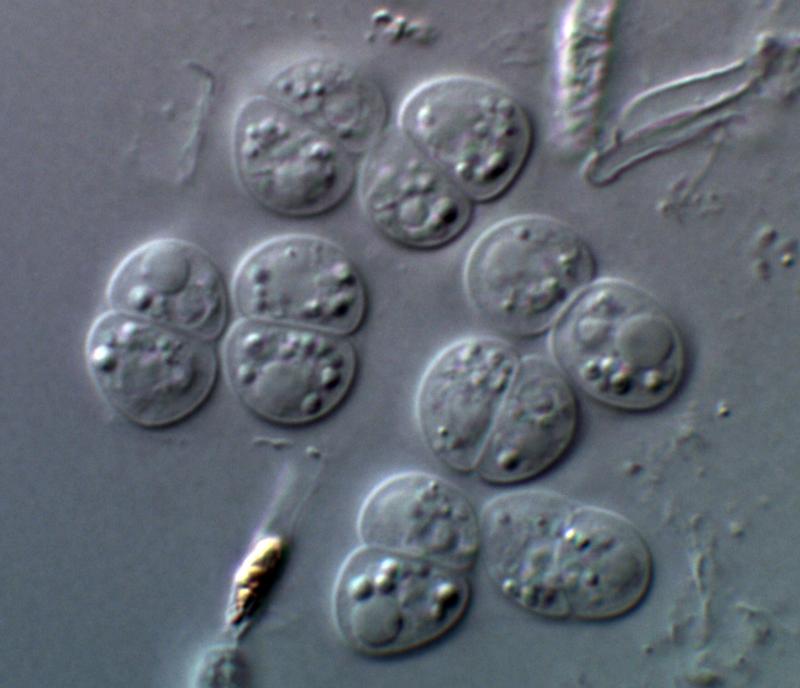
Associated with this apothecium were a number of two-celled hyaline bodies which appear fungal; these can be seen in the final photograph but also in #2.
I was wondering about Pezizellaceae? As ever, any comments would be appreciated.
Amitiés
Chris
Hans-Otto Baral,
14-11-2021 17:03

Re : Rubus fruticosus disco
Hi Chris
this reminded me of Calycellina separabilis, but the spores are much too short. Also, that species is strictly on R. idaeus as it seems, and it has croziers. With yours I am not sure with the absence of them.
You could test CRB if the spore sheath setectively stains bright lilac. Look at my photos Calycellina separabilis, HB 8584a-6, CRB
Did you change your E-mail address? I twice could not reach you.
Zotto
Chris Yeates,
14-11-2021 18:34
Re : Rubus fruticosus disco
Thanks Zotto
I agree, that species has a lot in common with my find. I will do some more work on it.
Spore length is clearly a problem, though in the protologue Karsten does say 8-15µm long. This site has a very large stand of Rubus idaeus immediately by where I found this and the two grow mixed together at the edge of it - indeed Orbilia rubrovacuolata seems to have "jumped" from fruticosus to idaeus here (I know I have mentioned this to you before). The substrate on one of the images in your C. separabilis folder looks rather like R. fruticosus.
My email address is csvy.myco@btinternet.com - I did change it, but quite a long while ago as I could only access the old one on my phone, and had to forward to the PC.
Best wishes, Chris
Hans-Otto Baral,
14-11-2021 22:12
Re : Rubus fruticosus disco
I now saw I used a wrong address. My addressbock is not available on my present computer, no time to install ist.
If you mean C. separabilis 8.IX.2007, it is by Luc Baily. Indeed these spines look unlike R. idaeus, but Luc indicated that host anyway.