
07-06-2026 15:10
 William Slosse
Hello everyone,On 05-06-26, I found following asco
07-06-2026 12:09
 François Freléchoux
Bonjour, Voici une brève description de ce qui m
05-06-2026 11:02
Thomas Læssøehttps://svampe.databasen.org/observations/10596691
07-06-2026 12:43
Steve ClementsBojour. This was a strange find on a stick on my
12-07-2015 00:05
 Nedim Jukic
This one from the same locality as the previous on
06-06-2026 17:44
Steve ClementsBonjour, This disco was on planed wood 3 x 1.5 cm
14-08-2016 23:15
 Alex Akulov
Dear friendsCan you help me to find the descriptio

04-06-2026 11:36
Gernot FriebesHi,found on Vaccinium myrtillus.Asci: IKI –, 8-s
Mollisia
Tania Jiménez,
18-10-2008 17:32
réaction positive dans le KOH en donnant une couleur jaune (macroscopiquement) cette caracteristique ne pas observe dans les paraphises (materiel d’herbier)
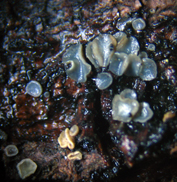
Tania Jiménez,
18-10-2008 17:36
Re:Mollisia
dans un état sec de couleur jaune et subicle de coloeur claire vers le marge
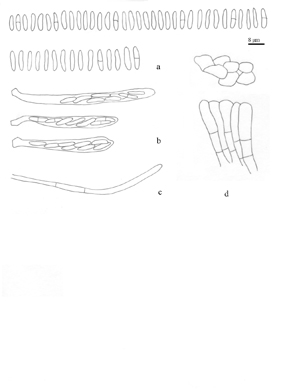
Tania Jiménez,
18-10-2008 17:45
Re:Mollisia
Pardon escipulum claire, brun dans le base de l'apotecium, qui est très petite (0,1-0,5 mm)
Merci!!
Merci!!
Hans-Otto Baral,
18-10-2008 17:48

Re:Mollisia
Dear Tania
Mollisia species are usually not very host specific, so identification of your fungus requires more data. Are the asci amyloid, croziers? How deeply brown is the excipulum, margin in section (hairs?).
Your images are too small. Did you put them as bmp? It seems so because loading is rather slow.
Important would also be some vital characters. Especially: are the spores inside the living asci always aseptate? Perhaps you can recollect the fungus?
Cheers
Zotto
Mollisia species are usually not very host specific, so identification of your fungus requires more data. Are the asci amyloid, croziers? How deeply brown is the excipulum, margin in section (hairs?).
Your images are too small. Did you put them as bmp? It seems so because loading is rather slow.
Important would also be some vital characters. Especially: are the spores inside the living asci always aseptate? Perhaps you can recollect the fungus?
Cheers
Zotto
Tania Jiménez,
18-10-2008 18:16
Re:Mollisia
Dear Hans
Asci amyloid, not croziers at the base, excipulum few brown. In the photography it can appreciate that in dry they are totally yellow.
The espores inside asci are always aseptate.
I Cannot recollet this fungus, The especimenes come from herbalist's material
The speciments were growing in a xeric environment (Cistus monspeliensis bushes) at Cap de Creus, Catalonia, Spain.
Asci amyloid, not croziers at the base, excipulum few brown. In the photography it can appreciate that in dry they are totally yellow.
The espores inside asci are always aseptate.
I Cannot recollet this fungus, The especimenes come from herbalist's material
The speciments were growing in a xeric environment (Cistus monspeliensis bushes) at Cap de Creus, Catalonia, Spain.
Tania Jiménez,
18-10-2008 18:58
Re:Mollisia
The page does not leave me to put the big images, I send you by e-mail
Hans-Otto Baral,
19-10-2008 11:16
Re:Mollisia
Dear Tania
I am quite unable to name this species. the characters are not very extraordinary, only the yellow KOH-reaction and the a bit large spores seem characteristic, also the xeric habitat. What I doubt a bit is the absence of croziers. You may be true, but this character requires careful observation and illustration in KOH plus Congo Red. It is a very clear character, but difficult to see anyhow. Most Mollisias have croziers but a few don't have, so the absence would be something like a "sensation".
Did you test Andreas Gminder' s or my Mollisia key?
Zotto
I am quite unable to name this species. the characters are not very extraordinary, only the yellow KOH-reaction and the a bit large spores seem characteristic, also the xeric habitat. What I doubt a bit is the absence of croziers. You may be true, but this character requires careful observation and illustration in KOH plus Congo Red. It is a very clear character, but difficult to see anyhow. Most Mollisias have croziers but a few don't have, so the absence would be something like a "sensation".
Did you test Andreas Gminder' s or my Mollisia key?
Zotto
Tania Jiménez,
19-10-2008 12:20
Re:Mollisia
dear Hans,
testing your keys it seems M. prunicola, but I don't have observed croziers, What might it do to observe the croziers?
Tania
testing your keys it seems M. prunicola, but I don't have observed croziers, What might it do to observe the croziers?
Tania
Tania Jiménez,
19-10-2008 12:31
Re:Mollisia
Macroscopically, neither it looks M prunicola...
Tania Jiménez,
19-10-2008 13:05
Re:Mollisia
Where I might find good descriptions of the speciesof the genre Mollisia? specielly of Mollisia benesuada
Thanks
Thanks
Hans-Otto Baral,
19-10-2008 16:19
Re:Mollisia
M. prunicola and M. rosae have long light brown hairs at margin and flanks,but I do not know that in your fungus. Good descriptions are f. ex. in Le Gal & Mangenot 1956-66, several papers in Bull Soc. mycol Fr. I remember there is also a description of M. benesuada (yes: 1960: 178).
Croziers: in herbarium material it is necessary to strongly squash the mount in KOH to which Congo red is added which stain the cell walls. Then the character should quit eeasily be seen.
Did you test the spores in KOH? because in dead material you may easily overlook guttules in the spores: In M. benesuada there are several distinct LBs at each spore end.
Zotto
Croziers: in herbarium material it is necessary to strongly squash the mount in KOH to which Congo red is added which stain the cell walls. Then the character should quit eeasily be seen.
Did you test the spores in KOH? because in dead material you may easily overlook guttules in the spores: In M. benesuada there are several distinct LBs at each spore end.
Zotto
Tania Jiménez,
19-10-2008 18:09
Re:Mollisia
My fungus don't have long and brown hairs at margin. Tomorrow I will take some photos and I will send it.
Tania
Tania