
07-06-2026 15:10
 William Slosse
Hello everyone,On 05-06-26, I found following asco
08-06-2026 17:00
François BartholomeeusenGood day everyone, On June 5 2026, I collected de
05-06-2026 11:02
Thomas Læssøehttps://svampe.databasen.org/observations/10596691
08-06-2026 10:16
 Spooren Marco
I don`t have a clou about this fungus,it is not in
07-06-2026 12:09
 François Freléchoux
Bonjour, Voici une brève description de ce qui m
07-06-2026 12:43
Steve ClementsBojour. This was a strange find on a stick on my
12-07-2015 00:05
 Nedim Jukic
This one from the same locality as the previous on
06-06-2026 17:44
Steve ClementsBonjour, This disco was on planed wood 3 x 1.5 cm
14-08-2016 23:15
 Alex Akulov
Dear friendsCan you help me to find the descriptio
I send you a Word document with my find on juncus.
Is my determination correct? I have my doubts. In Breitenbach(vol. 1 p. 146) it should be stalkless but taking into account the taxonomic corrections the determination is correct! Ellis and Ellis p.498 confirms my conclusion, so am I right or am I wrong.
Thanks in advance, kind regards,
François Bartholomeeusen
 GrasstromakelkjeAF-0001.docx
R. calopus is usually stalked. Your photo of an apically opened ascus in IKI shows a distinct bluing. Now important would be the ascus base. Did you see young asci emerging from the basal cells? Are there croziers or not?
There is a quite sharp delimitation between Poaceae (with croziers) and Cyperaceae/Juncaceae (without). From the substrate yours should be R. paludosa (or R. henningsiana which seems to be the older name).
There is a recent paper on this, by F. Pancorbo, Miguel-Angel Ribes et al. 2013.
Estudio micobiota ecosistema dunares Peninsula y Baleares I.
Bol. Soc. Micol. Madrid 37: 175-201
See also here
http://www.ascofrance.fr/search_forum/22183
Zotto
Thanks for your quick response, unfortunately I have no more material to investigate. I add some pictures, but I suspect they do not bring clarity.
In any case, many greetings,
François
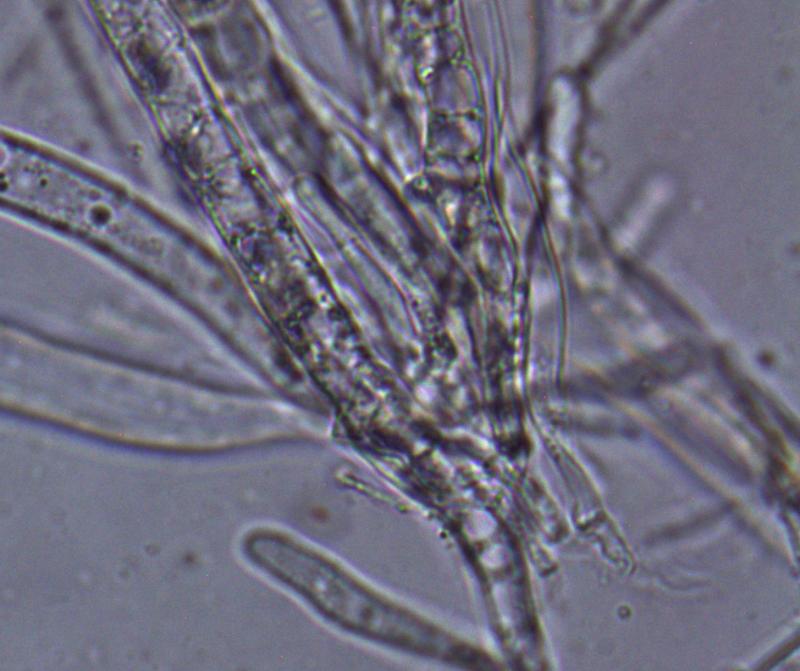
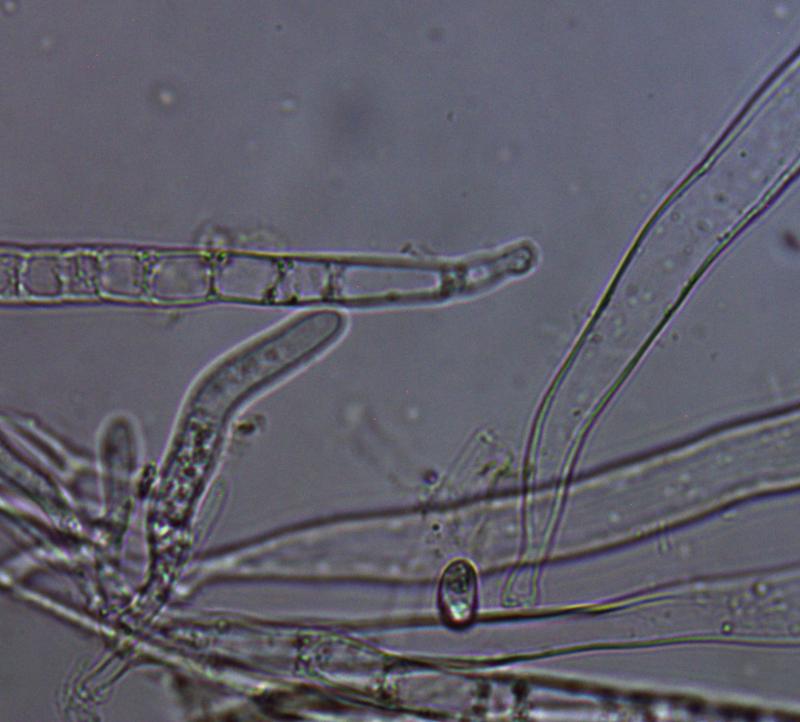
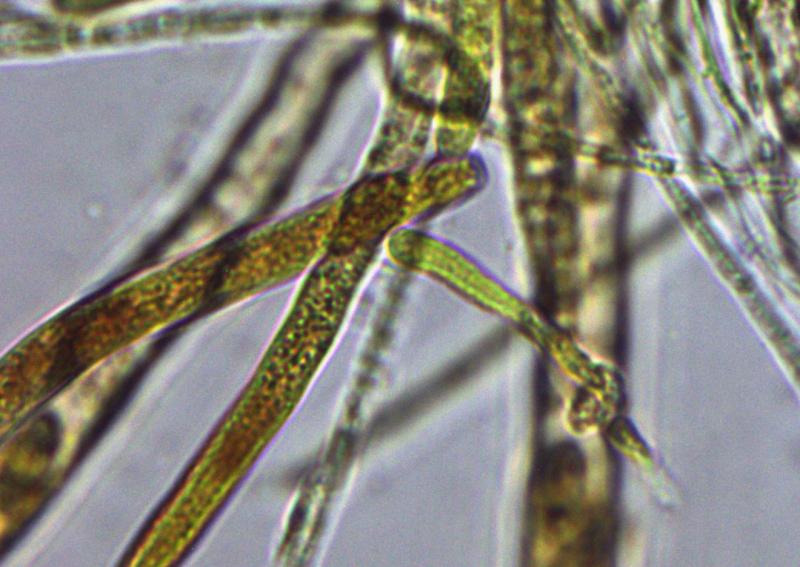

I am sending you the paper.
Good luck.
It is so nice to have friends...so far away... Many thanks for your help!
I revisited the site and with some difficulty discovered that the substrate is not Juncus effusus but Eleocharis palustris(Cyperaceae).
According to Bernard Declerck it's the first time that Rutstroemia paludosa was found in Flanders.
Kind regards,
François

I checked the collection received from François. The asci have indeed no croziers, only a basal bent protuberance.
I am interested in receiving the Pancorbo & al. paper too. Thanks in advance.
Best regards,
Bernard
Zotto