
07-06-2026 15:10
 William Slosse
Hello everyone,On 05-06-26, I found following asco
07-06-2026 12:09
 François Freléchoux
Bonjour, Voici une brève description de ce qui m
05-06-2026 11:02
Thomas Læssøehttps://svampe.databasen.org/observations/10596691
07-06-2026 12:43
Steve ClementsBojour. This was a strange find on a stick on my
12-07-2015 00:05
 Nedim Jukic
This one from the same locality as the previous on
06-06-2026 17:44
Steve ClementsBonjour, This disco was on planed wood 3 x 1.5 cm
14-08-2016 23:15
 Alex Akulov
Dear friendsCan you help me to find the descriptio

04-06-2026 11:36
Gernot FriebesHi,found on Vaccinium myrtillus.Asci: IKI –, 8-s
phaeohelotium monticola ou flexuosum
christian Deconchat,
24-10-2008 02:26
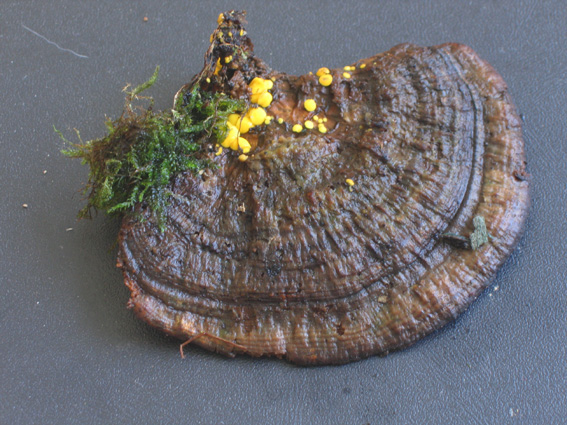
j'ai trouvé sur polypore (Dedaleopsis confragosa ou tricolor) ces petits ascos jaunes/. Au micro, j'ai des spores uni ou biseptées qui correspondent assez bien a Phaeohelotium monticola (ref BK champignons de Suisse) mais j'ai vu dans les fiches un P. flexuosum qui est ressemblant. Peut-on m'indiquer les différences entre les deux taxons? Existe-t-il d'autres Phaeohelotium proches. Une clé de ce genre me serait utile. Merci
christian Deconchat.
Nicolas VAN VOOREN,
24-10-2008 07:46

Re:phaeohelotium monticola ou flexuosum
Christian,
voici la clé de travail de Bernard Declercq. La différence entre les espèces rattachées au genre Phaeohelotium porte sur plusieurs caractères microscopiques, il paraît difficile de répondre sur les maigres informations que tu nous fournis (et la photo des ascomes est petite !)
Bon courage.
voici la clé de travail de Bernard Declercq. La différence entre les espèces rattachées au genre Phaeohelotium porte sur plusieurs caractères microscopiques, il paraît difficile de répondre sur les maigres informations que tu nous fournis (et la photo des ascomes est petite !)
Bon courage.
 5584.doc
christian Deconchat,
24-10-2008 08:43
Re:phaeohelotium monticola ou flexuosum
Merci Nicolas,
je vais essayer d'y voir plus clair.
c.deconchat
je vais essayer d'y voir plus clair.
c.deconchat
Hans-Otto Baral,
24-10-2008 12:45

Re:phaeohelotium monticola ou flexuosum
Hi Christian
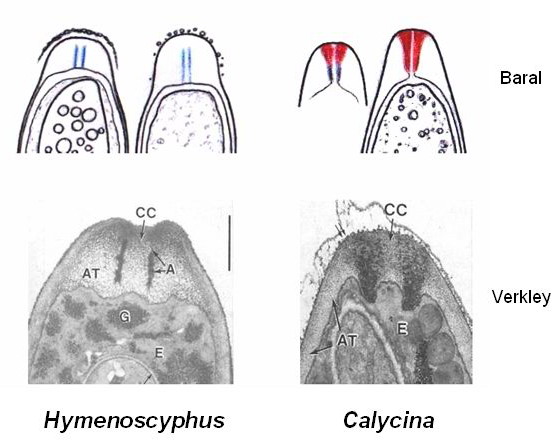
I recommend first to test with iodine (Lugol), in order to exclude the genus Bisporella/Calycina. B. citrina is easily confused with such a Phaeohelotium/Hymenoscyphus. In the attach you see the strong differences. To see them needs oil immersion and dead asci (shortly heating the slide over a flame). Species around H- monticola may also be inamyloid.
Ph. flexuosum is a synonym of Hymenosc./Phaeoh. imberbis and has white apothecia which turn red-brown.
Zotto
I recommend first to test with iodine (Lugol), in order to exclude the genus Bisporella/Calycina. B. citrina is easily confused with such a Phaeohelotium/Hymenoscyphus. In the attach you see the strong differences. To see them needs oil immersion and dead asci (shortly heating the slide over a flame). Species around H- monticola may also be inamyloid.
Ph. flexuosum is a synonym of Hymenosc./Phaeoh. imberbis and has white apothecia which turn red-brown.
Zotto
christian Deconchat,
26-10-2008 18:34
Re:phaeohelotium monticola ou flexuosum
Merci Zotto de tes précieuses informations. Je vais essayer de voir tout cela de plus près.
christian Deconchat
christian Deconchat